Topological Sort
The topological sort algorithm takes a directed graph and returns an array of the nodes where each node appears before all the nodes it points to.
Example 1
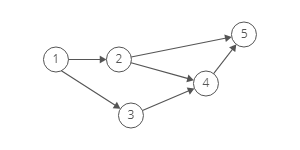
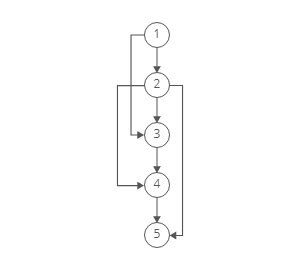 Graphs can have more than one valid topological ordering.
This graph has valid ordering of [1,2,3,4,5] or [1,3,2,4,5]
Graphs can have more than one valid topological ordering.
This graph has valid ordering of [1,2,3,4,5] or [1,3,2,4,5]
Algorithm
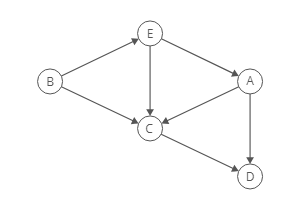
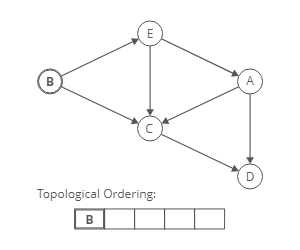
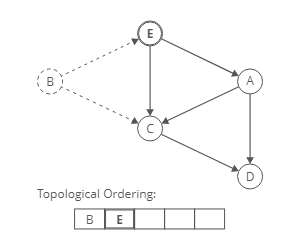
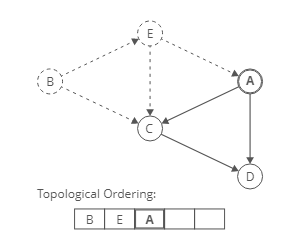
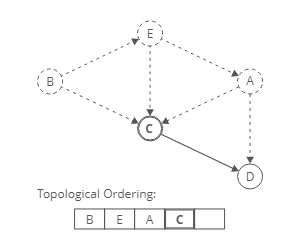
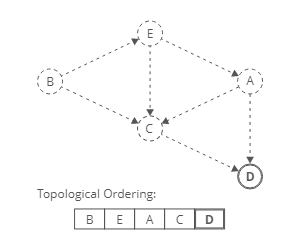
To produce a topological ordering for this directed graph we have to find the nodes with an Indegree of zero. Nodes with an indegree of zero come first.
Implementation
- Identify a node with no incoming edges.
- Add that node to the ordering.
- “Remove” it from the graph by decrementing indegree of neighbours
- Repeat.
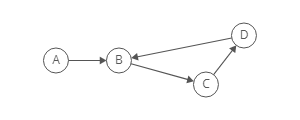
Topological Sort can be useful to find cycles in directed graphs as if a cycle exists there will always be a node with at least one incoming edge.
Example
Leetcode 207 - Course Schedule
class Solution {

    public boolean canFinish(int numCourses, int[][] prerequisites) {
        // Topological sort
        // Prereq array is all the edges

		ArrayList<ArrayList<Integer>> nodes = new ArrayList<ArrayList<Integer>>(numCourses);

        for (int i = 0; i < numCourses; i++) {
            nodes.add(new ArrayList<Integer>());
        }

        int[] degree = new int[numCourses];

        // Directed Graph, from edge[1] you can access edge[0]
        for (int[] edge : prerequisites) {
            nodes.get(edge[1]).add(edge[0]);
            degree[edge[0]] += 1; //Increment number of incoming edges
        }

        // For you to pass all courses, all courses must be doable
        // Courses cant be all doable if there is a cycle in the graph
        // Therefore there must be a node with zero incoming directed edges

        ArrayList<Integer> topSort = new ArrayList<Integer>();

        for (int i = 0; i < numCourses; i++) {
            if (degree[i] == 0) {
                topSort.add(i);
            }
        }

        for (int i = 0; i < topSort.size(); i++) {
            // Get nodes that are connected to current
            ArrayList<Integer> connectedNodes = nodes.get(topSort.get(i));
            for (int node : connectedNodes) {
                // Now that the current node has been recorded the connected nodes are decremented by a degree of one
                degree[node]--;
                if (degree[node] == 0) {
                    // If they are the degree 0 then that means they are next
                    topSort.add(node);
                }
            }
        }

        // If a cycle was detected then the node that creates the cycle would not have been appended
        return (topSort.size() == numCourses);
    }
}
Time Complexity
Let V be the number of Verticies (nodes) and E be the number of edges
-
Time complexity to determine the indegree for each node is O(E) as we must loop over all edges.
-
Then we must loop over all nodes and append all that have an indegree of zero to a list/stack. Appending is constant time so this take O(V).
-
Then loop over each node in our list/stack, pop off and decrement the connected edges, therefore O(V)
- Although a loop is used to decrement the edges we won’t count edges twice therefore it has an additional total time complexity of O(E).
Therefore total time complexity is O(V+E).
Space Complexity
Space complexity is O(V)
- Structure to store the integer number of indegrees for each node is O(V).
- Structure to store all nodes with no incoming edges is O(V) worst case. Worst case all nodes have zero edges
- Topological ordering result is O(V) worst case as all nodes will be in the ordering at the end if the graph has no cycles.
Uses
- Can be used to find cycles
- Can also be used to find order of a procedure where steps may be dependant on each other
- E.g baking a cake