Event Streaming
“Event streaming is the practice of capturing data in real-time from event sources like databases, sensors, mobile devices, cloud services, and software applications in the form of streams of events; storing these event streams durably for later retrieval; manipulating, processing, and reacting to the event streams in real-time as well as retrospectively; and routing the event streams to different destination technologies as needed. Event streaming thus ensures a continuous flow and interpretation of data so that the right information is at the right place, at the right time.”
Kafka is a distributed system consisting of servers and clients that communicate via a high-performance TCP network protocol. It can be deployed on hardware, virtual machines, and containers in on-premise as well as cloud environments.
Concept
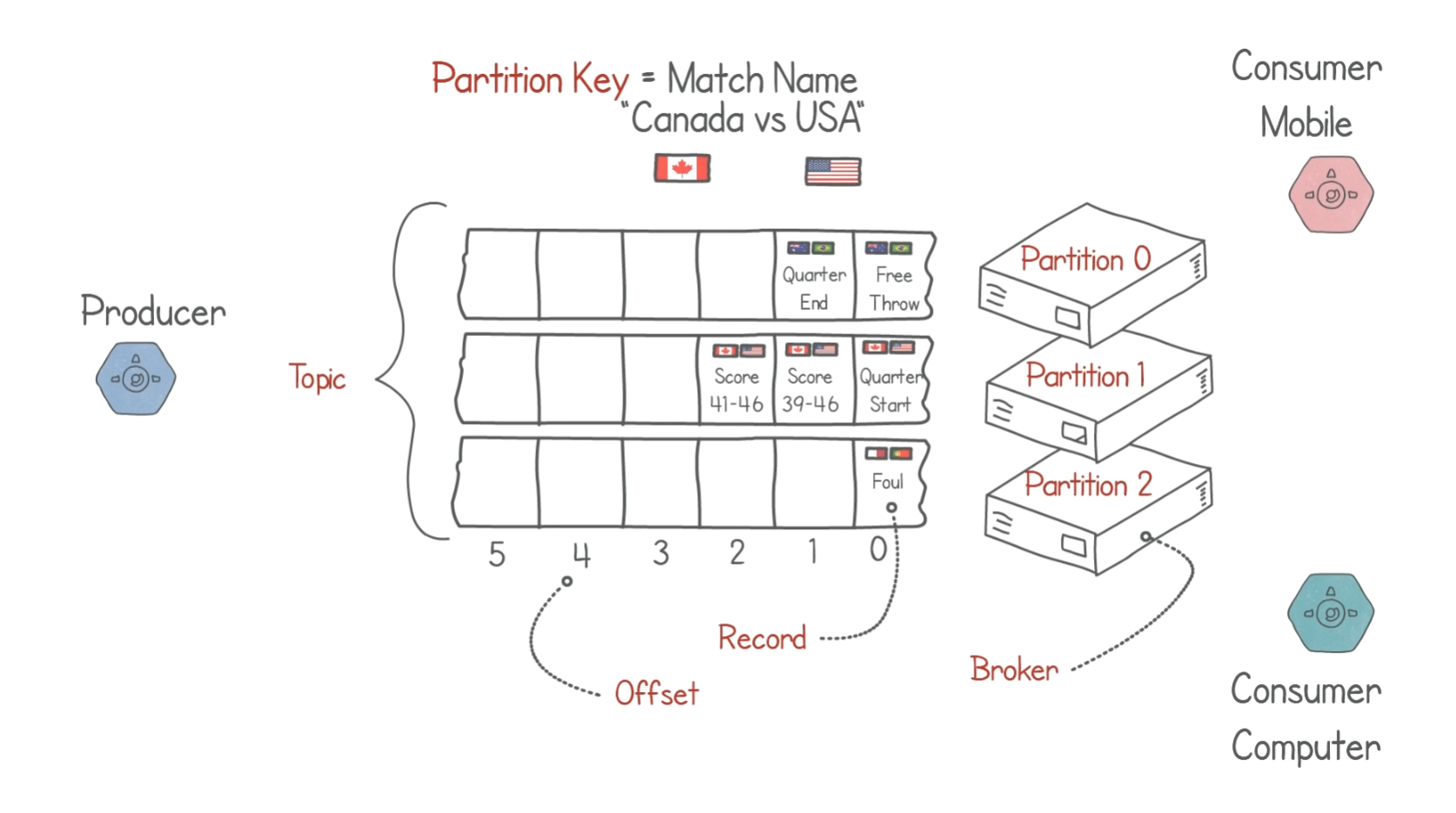
When an event occurs the producer creates a new record/event/message
Producers
- Receives updates and writes these ‘records’ into a queue
- This queue is usually referred to as a Kafka Topic
Topics
-
Messages in a Kafka topic are not delete when they are consumed/read
- Can use various policies to manage the messages
- Retention Policy
- Can set a rule to delete messages older than 24hrs
- Can also store older messages in Fault tolerant, persistent storage (Hard drive)
- Can be useful to recover previous messages if a Broker goes down
-
Topics can be organised into partitions
- This distributed placement of your data is very important for scalability because it allows client applications to both read and write the data from/to many brokers at the same time. When a new event is published to a topic, it is actually appended to one of the topic’s partitions
- Kafka guarantees that any consumer of a given topic-partition will always read that partition’s events in exactly the same order as they were written
Broker
- Brokers are the servers that these partitions run on
- To make your data fault-tolerant and highly-available, every topic can be replicated, even across geo-regions or datacenters, so that there are always multiple brokers that have a copy of the data just in case things go wrong, you want to do maintenance on the brokers, and so on. A common production setting is a replication factor of 3
Consumer
- Consumers consume the messages in the queue
- Listen for updates in real time
- Consumers are very lightweight and should be able to create many without affecting performance
- Use Offsets (pointers) to keep track of which latest message they have read