What is a socket
A socket is a way to speak to other programs using standard Unix file descriptors.
When Unix programs do any sort of I/O, they do it by reading or writing to a file descriptor. A file descriptor is simply an integer associated with an open file. But that file can be a network connection, a FIFO, a pipe, a terminal, a real on-the-disk file, or just about anything else. Everything in Unix is a file! So when you want to communicate with another program over the Internet you’re gonna do it through a file descriptor.
A server/application runs on a computer and has a socket bound to a specific port number. The server waits for a client to make a connection request on this port. Sockets are identified by a combination of IP address and a 16 bit port number, each separate application will use its own port number.
For a client to make a request we need to know the hostname and the port number that the server is listening on. The client application will also need to identify itself so it binds to a local port number that it will use during this connection, this port number is usually assigned by the system.
Upon acceptance, the server gets a new socket bound to the same local port and also has its remote endpoint set to the address and port of the client. It needs a new socket so that it can continue to listen to the original socket for connection requests while tending to the needs of the connected client.
Types of Internet Sockets
Stream Sockets
- SOCK_STREAM
- TCP (Transmission Control Protocol)
- Reliable two-way connected communication streams
- Data arrives sequentially and error free.
Datagram Sockets
- SOCK_DGRAM
- UDP (User Datagram Protocol)
- Unreliable. The packet may arrive and they may arrive out of order.
- Sometimes referred to as ‘connectionless sockets
- Do not need to maintain an open connection with a client
- Trade-off of using an unreliable protocol is speed.
- Use UDP if speed is important and the order of packets and potentially dropped packets dont matter.
Raw Sockets
- SOCK_RAW
- A raw socket allow user to implement it’s own Transport Layer Protocol above internet (IP) level .
- Implementation is responsible for creating and parsing transport level headers and logic behind it.
- Same level as TCP/UDP in Data Encapsulation
Data Encapsulation
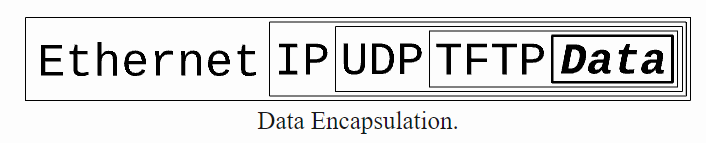 Data packet is encapsulated in a header by the first protocol (TFTP in this case). Then the entire thing including the TFTP headers are encapsulated in the next protocol (UDP in this case) and so on.
When a computer receives the packet, the hardware strips the Ethernet Protocol. The OS kernel strips the IP and UDP protocols. The TFTP program strips the TFTP headers and finally has the data.
Byte Order
Networks store bytes in Network Byte Order or Big-Endian. The byte order your machine uses is referred to as Host Byte Order. Some computers may store bytes in reverse, Little-Endian or it might be Big Endian as it is dependent on the machines architecture.
- Intel microprocessors are little endian
Hence never assume the Host Byte Order, there are functions to convert to Network host order.
- Code will also be portable if using the function otherwise code will only work on specific machines
Can convert short (two bytes) and long (four bytes) numbers.
Say you want to convert a
shortfrom Host Byte Order to Network Byte Order. Start with “h” for “host”, follow it with “to”, then “n” for “network”, and “s” for “short”: h-to-n-s, orhtons()(read: “Host to Network Short”).
| Function | Description |
|---|---|
htons() | host to network short |
htonl() | host to network long |
ntohs() | network to host short |
ntohl() | network to host long |